
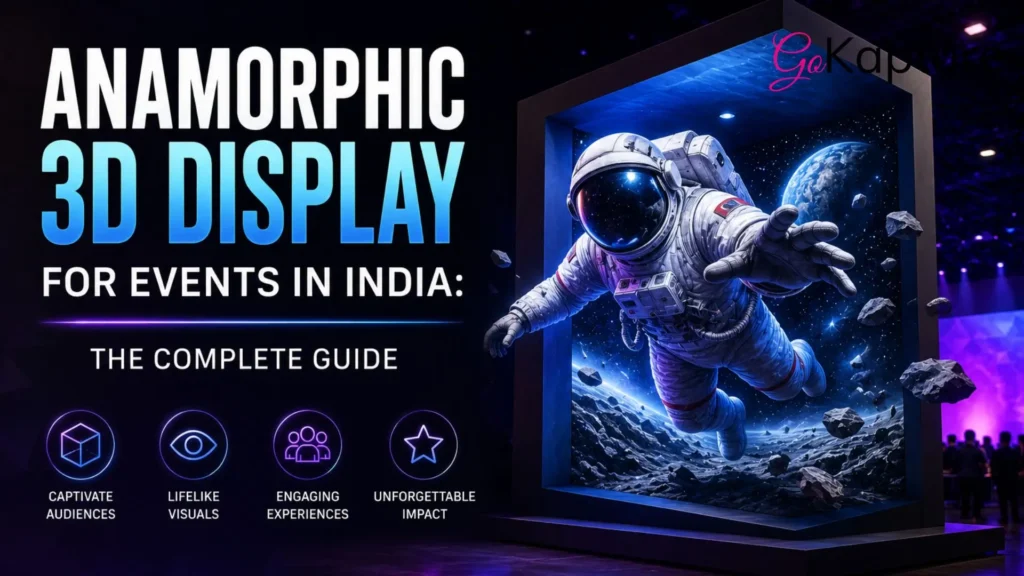
Anamorphic 3D Display for Events in India: The Complete Guide (2026)
Outline
- Introduction
- What is an Anamorphic 3D Display?
- Types of Anamorphic Display GoKapture Deploys
- What Makes Anamorphic Content Work?
- Where Anamorphic Displays Work Best
- Anamorphic vs Other Display Technologies – Which One Should You Choose?
- Why GoKapture for Anamorphic Displays in India
- Conclusion
- Frequently Asked Questions
Introduction
Picture this. An exhibition hall in Mumbai. Hundreds of stalls, thousands of visitors, every brand competing for the same five seconds of attention.
Then something happens at one stall. People stop. They pull out their phones. They call others over. They watch it again. They share the video.
No one is reading the brand’s name. No one is looking at the product specs. But every single person within 30 metres knows exactly who that stall belongs to — because they just saw something they’ve never seen before.
That’s what an anamorphic 3D display in India does.
And in 2026, it’s no longer reserved for global luxury brands with unlimited marketing budgets. GoKapture deploys anamorphic 3D content at corporate events, product launches, exhibitions, and brand activations across India — with custom content created in-house for each brief.
What is an Anamorphic 3D Display?
The word “anamorphic” comes from the Greek anamorphoûn — meaning “to transform.”
Anamorphic displays utilise a sophisticated optical illusion technique that combines high-resolution LED screens with distorted imagery that appears normal only when viewed from specific angles — creating the stunning illusion of three-dimensional objects emerging from flat surfaces.
In simpler terms: the content is deliberately designed to look “wrong” from most angles. But when viewed from one specific sweet spot — which is exactly where your audience stands — everything snaps into perfect 3D perspective. Objects appear to leap off the screen, float in space, or crash through the display surface.
It is not a hologram. No projection. No special glasses. No smoke or mirrors. Just a flat LED screen and content engineered to fool your brain.
And your brain falls for it completely — every time.
The Science Behind the Illusion
Your brain builds its understanding of depth from a set of visual cues — perspective, scale, shadow, and relative size. Anamorphic content is engineered to feed your brain precisely the right combination of these cues at exactly the right moment.
These installations create a “wow factor” by exploiting our brain’s programming to respond to environmental changes. When displays transition from static to dynamic 3D content, they generate surprise, unexpectedness, and emotional engagement — the core elements that drive memory encoding.
From anamorphic display product launch to anamorphic billboards, these 3D displays are fast becoming the go-to for a spectacular show and that viral moment you need.
The result is involuntary. You cannot “unsee” the 3D effect even when you know it’s a flat screen. Your visual system is simply wired to interpret those cues as depth — and it does so automatically, every time.
This is why anamorphic content goes viral so consistently. It’s not just visually impressive. It’s neurologically surprising — and surprise is the most powerful trigger for memory, sharing, and brand recall.
Types of Anamorphic Display GoKapture Deploys
1. Corner LED Anamorphic Display
What it is: Two LED panels meeting at a right angle — one horizontal, one vertical — forming an L-shaped or corner configuration. Anamorphic content is specially designed to span both panels simultaneously, using the corner as a “break point” where objects appear to shatter, emerge, or interact with the physical world.
Why the corner matters: The meeting point of two screens creates a natural depth reference that makes the 3D illusion dramatically more convincing. When a car appears to drive through the corner of the screen, or a product bursts out of the junction between the two panels, the audience’s brain has no framework for what it’s seeing — and the effect is overwhelming.
What it looks like in practice: A luxury SUV drives across the LED panels and crashes through the corner — the front of the car appearing to protrude into the real space in front of the screen. Defender became the first luxury automotive brand in India to use an anamorphic display at Phoenix Palladium, putting the SUV at the centre of a large digital screen that made it look like the vehicle was coming out towards the viewer.
Best for:
- Automotive product launches
- Luxury brand activations at malls
- Exhibition stalls with corner configurations
- Brand experience centres
Large-format product reveals
GoKapture advantage: We design the corner LED configuration and create the anamorphic content in-house — ensuring the screen geometry and content perspective are precisely matched for maximum effect.
2. Flat Screen Anamorphic Display
What it is: A single flat LED panel — any size — with anamorphic content that uses forced perspective to create the illusion of depth on a single surface. No corner required. Objects appear to float in front of the screen, fall toward the viewer, or retreat impossibly far into the display.
How it works differently from Corner LED: Without a physical corner as a reference, the flat screen anamorphic relies entirely on content design — shadows, scale shifts, motion blur, and perspective lines — to create the 3D illusion. When executed correctly, the effect is just as striking as the corner version.
What it looks like in practice: A product — a phone, a bottle, a car — appears to float metres in front of the screen, rotating slowly in full 3D. As it moves closer to the “camera,” it appears to grow and emerge toward the viewer. A gathering of people around an anamorphic screen signals to everyone else on the floor that something worth seeing is happening. Footfall compounds organically. The brand is associated with innovation instantly.
Best for:
- Exhibition stalls without corner configurations
- Stage backdrops at product launches
- Retail window displays
- Conference keynote backdrops
- Airport and transit advertising
What Makes Anamorphic Content Work
Here’s what most vendors won’t tell you: the display is only 10% of the experience. The content is 90%.
A badly designed anamorphic video on a perfect corner LED looks flat and unconvincing. A brilliantly engineered anamorphic file on an average single screen looks jaw-dropping.
GoKapture creates anamorphic content in-house. Here’s what goes into it:
Precise angle calibration: Every anamorphic file is built for a specific viewing distance and angle. Content designed for a 6-metre viewing distance looks wrong at 3 metres. We calibrate every piece of content to the actual venue geometry before delivery.
Physics simulation: The most convincing anamorphic content respects real-world physics — objects cast correct shadows, move with natural weight, and interact with the “real” environment of the screen. Content that ignores physics breaks the illusion instantly.
Brand integration: The 3D object is always the brand’s product or visual identity — not a generic effect. A HoloFan with a generic sphere is forgettable. A flat screen anamorphic with your actual product, your actual colours, and your actual launch campaign is an event moment.
Motion pacing: The illusion is strongest in the first 3 seconds. GoKapture’s content team engineers the opening frames to deliver maximum impact in that window — because that’s when the viewer’s brain is most vulnerable to surprise.
Where Anamorphic Displays Work Best in India
Product Launch
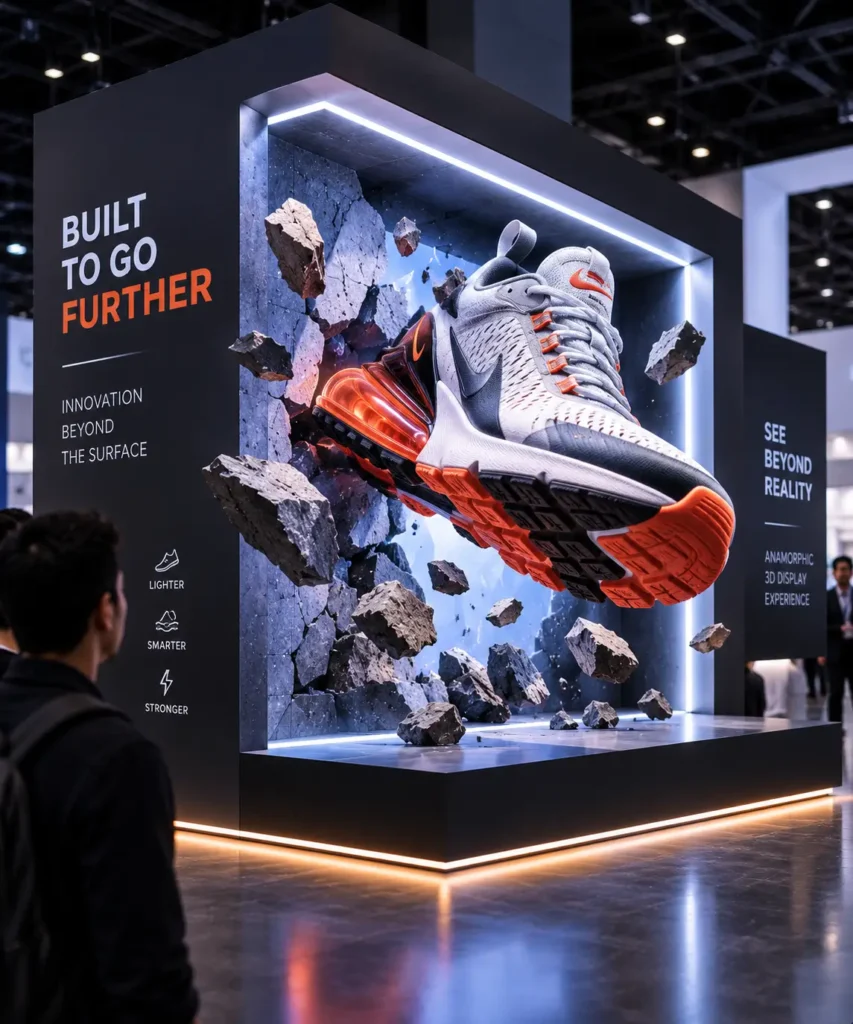
Anamorphic is the single most powerful visual tool for a product reveal. The product — a car, a phone, a bottle, an appliance — appears as a floating, rotating 3D object before the physical reveal. When the anamorphic display cuts to black and the physical product is unveiled, the contrast creates a theatrical moment that no other display technology can match.
GoKapture pairs anamorphic displays with LED Launch Cubes, robotic arms, and synchronized lighting for complete launch experiences.
Exhibition & Trade Show Stall
In a crowded exhibition environment, most displays compete visually but still feel similar. An anamorphic display immediately breaks that pattern.
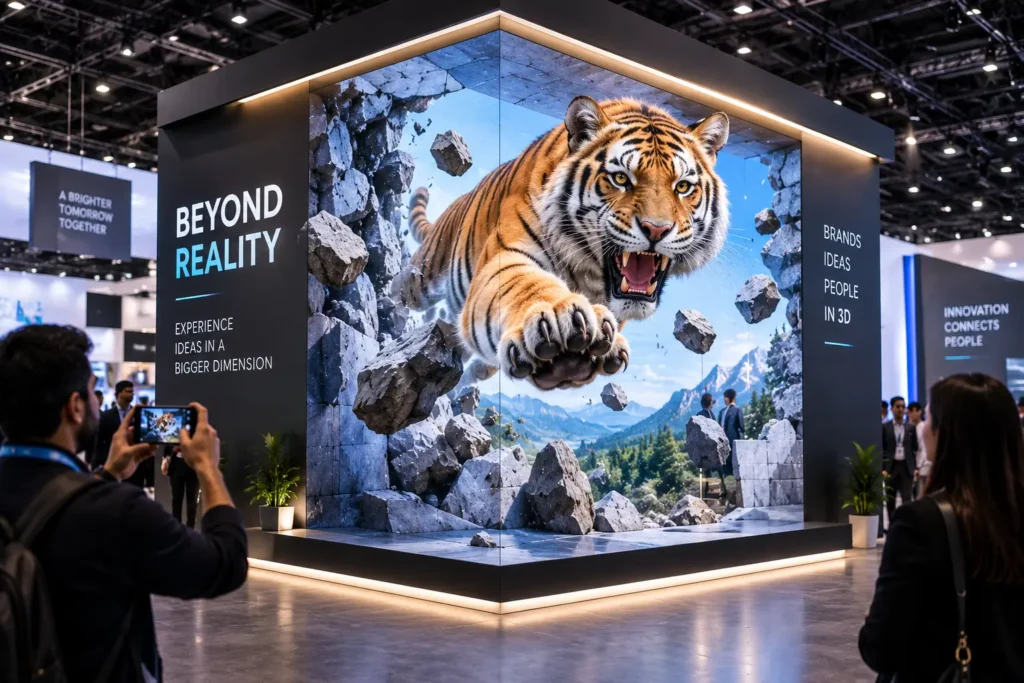
At any major Indian exhibition — Auto Expo, India International Trade Fair, Bharat Tex, CII events — an anamorphic display at your stall entrance creates a visible spectacle that draws footfall from across the hall. Visitors who weren’t planning to visit your stall stop, watch, and come in. The brand conversation starts before a single word is spoken.
Mall Activation & Brand Activation
Anamorphic OOH advertising refers to specially designed 3D content created for digital screens, typically using L-shaped or corner LED screens. India’s out-of-home advertising ecosystem is evolving rapidly, and anamorphic displays are emerging as one of the most talked-about innovations in this space.
For mall activations, anamorphic displays serve a dual purpose — they pull physical footfall in the moment, and they generate organic social media content that extends reach far beyond the activation’s physical location. Every person who videos the display and shares it is essentially a free media placement.
Conference & Corporate Event Backdrop
A conference stage with an anamorphic backdrop creates an immediate impression of technological sophistication — before a single speaker takes the stage. For tech companies, automotive brands, and FMCG giants presenting to dealer networks or channel partners, an anamorphic backdrop signals ambition and innovation in a way that a standard LED backdrop never can.
Retail & Brand Experience Centres
Permanent or semi-permanent anamorphic installations in showrooms, brand experience centres, and retail flagships create a recurring wow moment for every new visitor. Automotive showrooms, luxury retail, and consumer electronics brands in India are adopting anamorphic displays as a long-term brand environment investment.
Anamorphic vs Other Display Technologies — Which Should You Choose?
| Feature | Anamorphic | HoloFan | HoloBox | Standard LED |
|---|---|---|---|---|
| 3D Effect | ✅ Strong | ✅ Strong | ⚠️ Moderate | ❌ None |
| Viewing Distance | 3–15 metres | 1–5 metres | 1–3 metres | Any |
| Content Required | Custom | Custom | Custom | Standard |
| Viral Potential | ⭐⭐⭐⭐⭐ | ⭐⭐⭐⭐ | ⭐⭐⭐ | ⭐ |
| Space Required | Medium–Large | Small | Small–Medium | Any |
| Best Setting | Large events, launches, malls | Exhibition stalls, launches | Stalls, retail | Anywhere |
| GoKapture | ✅ | ✅ | ✅ | ✅ |
Choose Anamorphic when: You have a large screen or corner LED available, a significant viewing audience, and a product or brand visual worth showcasing dramatically.
Choose HoloFan when: You need a smaller footprint, indoor exhibition setting, and a floating product or logo effect.
Choose HoloBox when: You need a life-size virtual presenter or spokesperson at a stall or event.
Why GoKapture for Anamorphic Displays in India
Content created in-house. GoKapture’s content team builds anamorphic videos in-house using 3D animation and Unity-based rendering. We don’t outsource content — which means faster turnaround, better brand alignment, and full control over every frame.
Screen configuration expertise. Getting the anamorphic illusion right requires matching the content perspective to the exact screen geometry. GoKapture does this calibration for every deployment — ensuring the effect lands perfectly for the actual audience at the actual venue.
End-to-end delivery. We provide the content, the screen, the setup, and the operator. You share the brief — we deliver the experience.
9 metro cities. GoKapture deploys anamorphic displays across Delhi, Mumbai, Bengaluru, Hyderabad, Chennai, Pune, Kolkata, Ahmedabad, and Jaipur. One partner, one invoice, anywhere in India.
Pairs with other tech. Anamorphic displays become significantly more powerful when paired with other GoKapture products — an LED Launch Cube countdown leading into an anamorphic product reveal, or a robotic arm unveiling a product alongside a floating anamorphic preview. We design these multi-element experiences regularly.
Conclusion
Anamorphic 3D display is the most cost-effective way to create a genuinely jaw-dropping visual moment at a corporate event, exhibition, or brand activation in India.
It requires no special technology beyond the LED screen you likely already have. It creates social media content organically — guests share it without being asked. And it positions your brand as forward-thinking and premium before a single word about the product is spoken.
GoKapture creates the content, configures the screen, and operates the display on-site — across 9 Indian cities.
Share your event brief with us. We’ll tell you whether anamorphic is right for your venue, your product, and your audience — and we’ll deliver it flawlessly.